


Experienced Tax Relief Attorneys in Wyoming
Wyoming remains one of the most taxpayer-friendly states in the U.S. The state imposes no personal or corporate income tax, meaning residents pay no state tax on wages, retirement income, or capital gains. Instead, Wyoming funds public services primarily through sales, property, and severance taxes from natural resource extraction.
The state sales tax rate is 4%, with counties allowed to add up to 2% in local options, bringing total rates to as high as 6% in areas like Cheyenne and Jackson. According to the Wyoming Department of Revenue, groceries remain exempt from state sales tax, providing added relief for families.
Homeowners can also benefit from several property tax relief programs. The Wyoming Property Tax Refund Program offers refunds for eligible low- and moderate-income residents whose taxes exceed 10% of household income. Veterans may claim up to a $6,000 property exemption, and starting in 2025, long-term senior homeowners aged 65+ with 25 years of Wyoming tax payments may receive a 50% exemption on their primary residence and up to 35 acres. Applications are typically due to the County Assessor’s Office by the fourth Monday in May.
Whether you’re applying for Wyoming Property Tax Relief 2024, managing an IRS debt, or resolving state tax issues, our attorneys provide expert guidance to help Wyoming residents secure lasting financial peace.
Comprehensive Tax Help for Wyoming Residents
Every taxpayer’s situation is unique. Our Wyoming tax relief attorneys design personalized strategies that address IRS issues, property tax concerns, and county filing requirements — ensuring you receive every available benefit under state and federal law.
Federal & Back Tax Resolution
Our team provides full support for individuals and businesses facing IRS debt or collection actions. We help you qualify for federal programs such as:
- Offer in Compromise (OIC): Settle your IRS tax liability for less than the full amount owed if you can demonstrate financial hardship and have all filings up to date.
- Penalty Abatement: Remove or reduce penalties caused by late filing, reasonable cause, or first-time errors.
- Installment Agreements: Establish structured monthly payment plans that stop collections and protect your wages or bank accounts.
All processes follow current IRS procedures and are compliant with 2025 guidelines, ensuring your resolution plan meets federal requirements and preserves your long-term financial stability.
Property Tax Relief & Refund Programs in Wyoming
Wyoming offers several targeted property tax relief programs for homeowners, seniors, veterans, and low-income residents.
- Wyoming Property Tax Refund Program (2024): Eligible homeowners may receive a refund of up to 75% of property taxes paid, not exceeding one-half of the median residential tax for their county. Qualification is based on income (up to 145% of county median) and assets below the statewide limit, excluding the primary residence, one vehicle, and retirement accounts.
- Veterans Property Tax Exemption: Provides approximately $350 in annual tax reduction beginning in 2025 (up from $175 previously). This exemption applies to a principal residence or one motor vehicle owned by a qualifying veteran or surviving spouse. Applications must be filed with the County Assessor by the fourth Monday in May.
- County Hardship Relief: Counties such as Carbon and Natrona may offer temporary property tax deferrals or hardship exemptions for homeowners experiencing financial strain or medical hardship.
Our attorneys assist in preparing eligibility documents, coordinating with county assessors, and filing refund or exemption applications before the annual deadline.
Audit Representation & Tax Defense
Whether you’ve received a notice from the IRS or the Wyoming Department of Revenue, we provide full audit representation. Wyoming’s Department of Audit performs compliance checks on businesses and individuals, often verifying sales, use, and excise tax records. We handle all correspondence, prepare documentation, and defend your case to minimize additional taxes or penalties. Businesses should retain invoices, receipts, and exemption certificates for at least three years, as required by state audit rules.
Filing Corrections, Refund Claims & Payment Arrangements
If you’ve made an error on a prior filing or missed a deduction, we can help file amended returns (such as IRS Form 1040-X) and pursue refund recovery for both state and federal returns. We also negotiate installment payment plans that fit your budget and ensure compliance with both IRS and Wyoming Department of Revenue guidelines.

A Wyoming Tax Team You Can Trust
Our seasoned pros understand Wyoming tax rules—including business, sales, and property—alongside IRS regulations. Every case is unique, so we craft a plan to solve today’s issue and help prevent the next one.
With deep knowledge of Wyoming state tax law, including property and sales tax, as well as IRS regulations, we’re equipped to handle the complexities of tax resolution. Whether you’re an individual taxpayer or a business owner, our goal is to resolve today’s challenges and help prevent future ones.
qualified employees
fighting to lower your tax liability
of tax resolution experience-
our founders are experts
Millions of dollars
in tax liability reduction negotiation every year
Discover Peace of Mind with Tax Resolution
Our primary goal is to bring you peace of mind and financial stability. We are committed to negotiating with tax authorities on your behalf, seeking resolutions such as installment agreements, offers in compromise, or penalty abatements that best suit your financial situation.
Recognizing the stress and burden that tax liability can bring, our firm ensures a compassionate, confidential, and diligent service. With our guidance, many Californians have successfully navigated their way out of tax liability, and we are here to help you do the same.
Begin your journey towards financial relief today and take the first step in resolving your tax challenges with confidence.

I highly recommend their services...

Common Questions About Wyoming Taxes
Does Wyoming have a state income tax?
No. Wyoming does not impose a state income tax, which means residents are not required to pay state taxes on wages, self-employment income, or retirement earnings. The same applies to investment income, Wyoming does not tax dividends, interest, or capital gains at the state level. This absence of personal and corporate income taxes is one of the key reasons Wyoming is consistently ranked among the most taxpayer-friendly states in the country.
Does Wyoming tax capital gains or retirement income?
No. Wyoming does not tax capital gains, pensions, Social Security benefits, or other forms of retirement income. This makes it especially attractive to retirees and investors seeking long-term tax stability. Residents can receive full retirement benefits without state-level deductions or reporting requirements beyond federal filings.
What is the sales tax rate in Wyoming?
Wyoming’s state sales tax rate is 4%, but local counties are permitted to add up to 2% in optional taxes, resulting in a combined rate ranging from 4% to 6% depending on the area. For example, Cheyenne and Jackson often apply the full 6% combined rate. The Wyoming Department of Revenue confirms that groceries remain exempt from state sales tax, which helps lower overall household expenses for residents.
Does Wyoming have property tax?
Yes. Wyoming levies property taxes at the county level, with an average effective rate of about 0.55% — one of the lowest in the nation. Property taxes primarily fund local services such as schools, road maintenance, and law enforcement. Although rates vary slightly by county, Wyoming homeowners generally enjoy low annual property tax bills compared to national averages.
What property tax relief is available for Wyoming homeowners?
Wyoming provides several programs to reduce the property tax burden for eligible residents. The Wyoming Property Tax Refund Program offers refunds of up to 75% of property taxes paid, capped at one-half of the county’s median residential tax amount. To qualify, households must have incomes below 145% of their county’s median income, and certain assets—such as the primary home, one vehicle, and retirement savings—are excluded from the limit. Veterans may apply for an annual property tax exemption worth about $350 starting in 2025, while seniors aged 65 and older who have paid property taxes in Wyoming for more than 25 years may qualify for a new Long-Term Homeowners Exemption beginning in 2025, which provides a 50% exemption on their primary residence and up to 35 acres. Applications for these programs are typically due to the County Assessor’s Office by the fourth Monday in May each year.
When are property taxes due in Wyoming?
Wyoming property taxes are billed in September and can be paid in two equal installments — the first due on November 10 and the second on May 10 of the following year. Homeowners may also choose to pay the full amount by the first deadline without penalty. Counties handle their own billing and payment processing, so it’s important to check local requirements and postmark deadlines to avoid late fees.
Does Wyoming have an estate or inheritance tax?
No. Wyoming does not impose estate or inheritance taxes. Only the federal estate tax applies, and that affects only very large estates exceeding the federal exemption threshold. As a result, most Wyoming residents will never owe estate taxes at either the state or federal level.
Is Wyoming a tax-free or “tax haven” state?
While Wyoming is not entirely tax-free, it is often described as a tax haven due to its combination of no state income, inheritance, or capital gains taxes and its comparatively low property and sales tax rates. This favorable tax climate attracts both retirees and business owners looking for long-term financial predictability and limited state-level tax obligations.
Why Choose Tax Relief Helpers in Wyoming?
Our team combines deep expertise in IRS dispute resolution with a precise understanding of Wyoming’s property tax and relief systems. We stay current with all 2024–2025 updates, including the 75% refund cap, the expanded veterans exemption, and the new long-term homeowner provisions. Whether you’re managing a complex IRS case or applying for Wyoming Property Tax Relief, we ensure your filings are accurate, timely, and maximized for every eligible benefit.
Latest Wyoming Tax Insights
Self-Employed & Freelancer Tax Help, Tax Filing Deadlines & Extensions, Taxes for Freelancers & Self-Employed
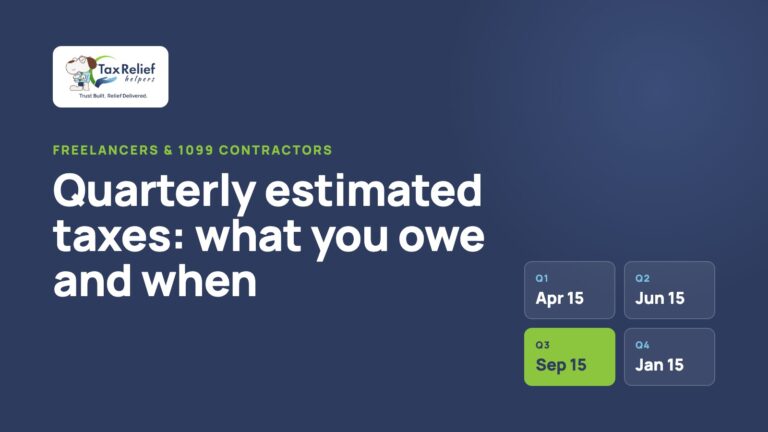
Quarterly Estimated Taxes for 1099 Contractors: What You Owe and When
Freelancers and 1099 contractors pay tax four times a year. Here are the 2026 estimated tax deadlines, how much to set aside, the safe harbor…
Currently Not Collectible Status: How to Qualify When You Can’t Pay the IRS
Currently Not Collectible (CNC) status is an IRS hardship determination that pauses wage garnishments, bank levies, and collection notices when you can’t afford to pay.…
What’s the Difference Between an IRS Installment Agreement and an Offer in Compromise?
If you owe back taxes, the IRS offers several programs designed to help taxpayers resolve their debt. Two of the most common options are an…
A Step by Step Guide to the Tax Relief Process with Tax Relief Helpers
1.
Step 1: Initial Contact and Consultation
Reach Out: Begin by contacting our firm via phone, email, or through our website. We offer an initial consultation, which is often free, to discuss your tax situation.
Consultation: During this consultation, you’ll speak with a tax attorney or a qualified tax professional who will assess your tax issues and provide preliminary advice.
2.
Step 2: Gathering and Reviewing Documentation
Information Collection: You’ll be asked to gather and provide all relevant financial documents, tax records, and any correspondence with tax authorities.
Comprehensive Review: Our team will meticulously review these documents to understand the full scope of your tax liabilities and identify potential relief options.
3.
Step 3: Developing a Strategy
Tailored Plan: Based on the review, we’ll develop a customized strategy that aligns with your specific circumstances and goals.
Discussion and Approval: We’ll discuss the proposed strategy with you, ensuring you understand all aspects and agree with the approach.
4.
Step 4: Representation and Negotiation
Representation: As your representatives, we’ll contact the IRS or state tax authorities on your behalf.
Negotiation: We will negotiate with tax authorities, leveraging our expertise and knowledge to seek the best possible outcome, whether that’s an installment agreement, offer in compromise, or another relief solution.
5.
Step 5: Resolution and Agreement
Finalizing the Agreement: Once an agreement is reached with the tax authorities, we’ll ensure all documents are accurately prepared and submitted.
Negotiation: We will negotiate with tax authorities, leveraging our expertise and knowledge to seek the best possible outcome, whether that’s an installment agreement, offer in compromise, or another relief solution.
6.
Step 6: Compliance and Future Planning
Ensuring Compliance: We provide guidance on complying with the terms of the agreement to prevent future liabilities.
Future Tax Planning: Our team offers advice and planning services to help you manage your taxes going forward, avoiding similar issues.
7.
Step 7: Ongoing Support and Consultation
Continuous Support: Even after your tax issue is resolved, we’re available for any further questions or additional assistance.
Periodic Check-ins: We offer periodic check-ins or consultations to help you stay on track with your tax responsibilities.