
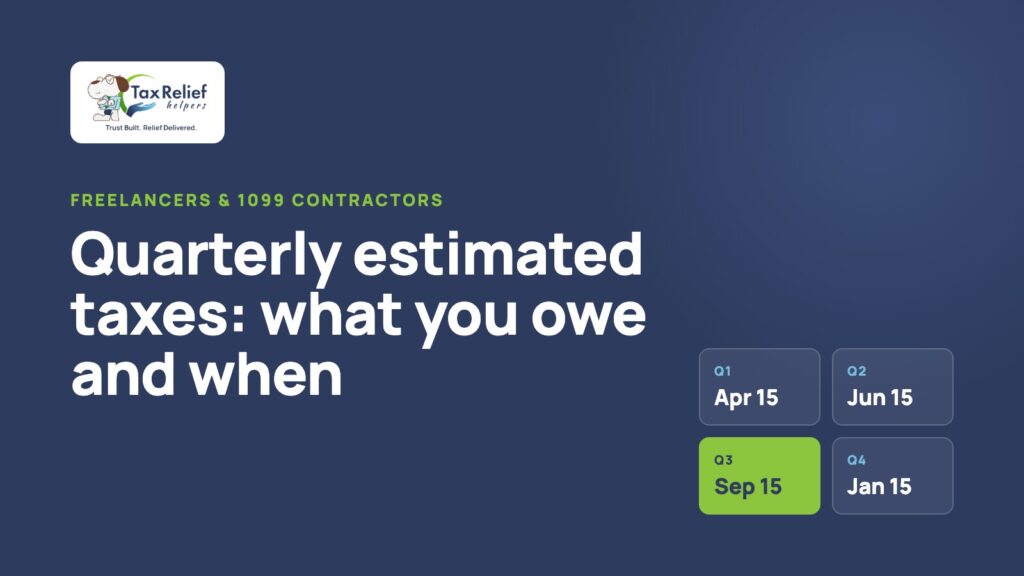
If no one withholds tax from your pay, the IRS expects you to do it yourself, four times a year. Here’s the schedule, the math, and the forms, in the order you’ll need them.
It covers income you earned June 1 through August 31. Pay what you can by the deadline, even if the number is an estimate. A late payment accrues interest, an unfiled one accrues penalties on top of it.
The 2026 Estimated Tax Schedule
Estimated tax is paid as you earn, not in one lump sum when you file. Four periods, four deadlines:
If a due date lands on a weekend or federal holiday, it moves to the next business day. Most states have their own estimated tax calendar too, so check yours.
How Much to Set Aside
Self-employment tax covers Social Security (12.4%) and Medicare (2.9%). You pay both the employer and employee share, and it sits on top of regular federal income tax.
Move that money the moment a payment clears. Higher earners and people in states with income tax should lean toward the top of the range.
The safe harbor rule
You won’t owe an underpayment penalty if your payments add up to at least 90% of this year’s tax or 100% of last year’s tax, whichever is smaller. If last year’s adjusted gross income was over $150,000, that second number is 110%.
The easy version: take last year’s total tax, divide it by four, and pay that each quarter.
How to Pay
Pay online or mail a voucher. Keep the confirmation number for every payment, since you’ll report the total on your return.
Forms to Know
Form W-9
A client asks you to fill this out before paying you. It has your legal name, address, and taxpayer ID. It goes to the client, not the IRS.
Form 1099-NEC
Sent by any client who paid you $2,000 or more in 2026 (it was $600 through 2025). It’s a summary, not a bill. Income without a 1099 still has to be reported.
Form 1040-ES
The worksheet and vouchers for your quarterly payments. Redo it mid-year if your income changes a lot.
Schedule SE
Figures your 15.3% self-employment tax. It applies to single-member LLCs too, and half of it is deductible.
Form 1040 and Schedule C
Your annual return. Schedule C reports business income and expenses. Gross receipts minus deductible expenses is the net profit your tax is based on.
When to Bring In Help
Plenty of freelancers handle a simple year on their own. These situations are worth a professional’s time, and they get more expensive the longer they sit:
- You have unfiled returns from one or more past years.
- You owe the IRS more than $10,000, or penalties and interest are already adding up.
- You got an IRS notice, like a CP14 balance due, a CP504, or a Letter 1058 levy warning.
- A lien, levy, or wage garnishment has been filed or threatened.
- Your income jumped enough that last year’s safe harbor no longer covers you.
Tax Relief Helpers works with freelancers and 1099 contractors to get returns filed, stop collections, and settle what’s owed through an installment agreement or offer in compromise, or penalty relief when you qualify.
Behind on filing or facing a balance? Talk to us first.
A quick call tells you where you stand and what your options are.
Hablamos español.This is meant as a guide, not professional advice. If you have questions about your taxes or deductions, talk to an accountant or tax professional. If you’re behind on filing or owe the IRS more than $10,000, call Tax Relief Helpers for a free consultation.